| |
Accounting for the Decade
As the Republic of Armenia marked its thirteenth anniversary of independence and sovereignty, the Armenian Center for National and International Studies (ACNIS), an institutional pioneer of independent policy research and analysis in the post-Soviet space and a leading regional think tank, celebrated its first decade of public service. On this occasion the Center received hundreds of congratulations from dignitaries and diplomats, scientists, intellectuals, artists, public figures, businessmen, representatives of NGOs, Diaspora and the mass media, including His Holiness Karekin II, Catholicos of All Armenians, Prime Minister Andranik Margarian, Chief Justice Gagik Haroutiunian of the Constitutional Court, Academicians Fadey Sargsian, Grigor Gurzadian, and Rafael Ghazarian, world-renowned philanthropist and long-time ACNIS supporter Kirk Kerkorian, former US Secretary of State James Baker, Arab League Secretary General Amre Moussa, and scores of important others.
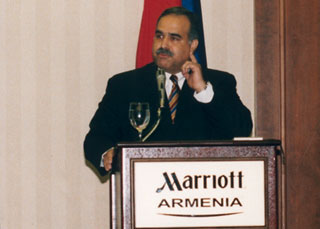
“In a relatively short period of time, ACNIS has helped place Armenian scholarship and analyses on public and foreign policy issues on the global map of research and policy outreach institutions. By promoting Armenia’s views, concerns and aspirations to a worldwide audience, ACNIS has contributed not only to generating ideas but also to linking Armenia to the international community. It has brought to bear Armenia’s intellectual potential on national and international challenges. As an American-Armenian, I feel a particular pride in ACNIS strength and reputation as a national think-tank with a global reach, ACNIS has accomplished in ten years what many leading American institutions achieve in decades,” writes Vartan Gregorian, President of the Carnegie Corporation of New York.
“The name of the Center itself proves the broad interests and activities of this research group of high professionals brilliantly representing the capacities of the intellectual potential present in the society. It is my strong belief, that such think-tanks are vital especially for countries undergoing transitional period and establishing respect towards democracy and human rights. In view of this, you should be proud of your efforts to pave the way for Armenia to become a member of the family of European states,” says Greek Ambassador Antonios Vlavianos. “The United States Government has had the privilege of working with ACNIS since its inception, and we consider the Center to be a valuable ally in the task of strengthening democracy, civil society, and public political-economic discourse in Armenia,” remarks US Ambassador John Ordway. “ACNIS has always pursued a policy of sharing common interests and involving regional countries and traditional partners in its activities and has had an impartial and positive impact on political developments and political process in the country,” continues Iranian Ambassador Mohammad Farhad Koleini.
“The Center is not only an embodiment of a profound idea to look into the mysterious dynamics of international life and on the basis of the acquired knowledge to develop strategies of possible actions, but also vivid manifestation of new realities in the Caucasus and in Armenia. Intellectual product of the Center could be enormously helpful to educate the world about this important area of the global landscape and to educate the area about the intricacies of the world,” opines Alexander A. Bessmertnykh, Former Foreign Minister of the USSR, Chairman of the World Council of Former Foreign Ministers, and President of International Foreign Policy Association. “I would like to emphasize the outstanding role in making all these happen of Mr. Raffi Hovannisian, Armenia’s first Minister of Foreign Affairs. His ability to analyze and to unwind most difficult and hard-shelled problems of international politics as well as his talent to make friends are greatly valued by his colleagues from the World Council of Former Foreign Ministers in which he is a prominent and active member,” he concludes.
Reflecting on ACNIS and its role, founder Raffi K. Hovannisian opened the official 10th anniversary banquet: “The Armenian Center for National and International Studies and its first ten years have been committed to the cause of institution-building and, often against the odds, to the forging of an infrastructure for a new political culture in which the free competition of ideas reigns within a national framework, and where rational and national policy options are sought in the domestic and international arenas through the creation of a comprehensive policymaking system for the Republic of Armenia and the nation entire.”
Regional cooperation and resolution of conflicts also constitute a major part of ACNIS’s 10-year track record. Hence the dinner celebration was marked by Finnish Foreign Minister Erkki Tuomioja’s keynote address, which asserted that the European Union is better equipped for “addressing the root causes of conflicts.” “The Union is not and will not become a military great power, but it can become an effective actor in conflict prevention and crisis management,” he added.

Though the Republic of Armenia has made efforts toward democracy since its independence, and despite its commitment to historical partners and closer cooperation with the European Union and the United States, Armenia is often excluded from participation in regional economic and energy projects. Not all of its citizens have benefited from the fruits of development, and rampant corruption and violations of due process have disillusioned the body politic. These factors, as well as the breadth and depth of public demand for compilation of a strategic program to ensure dignified elections, systemic stability, and devotion to democratic values, compelled the Center to launch a series of public and expert opinion polls in 2004. This has helped to promote among decisionmaker and citizen alike a new civic culture and societal consensus-building in Armenia, given the systemically defective presidential and parliamentary elections of 2003 during which the outcome depended little on public opinion and awareness.
As a link between innovative scholarship and the challenges facing Armenia, ACNIS has always played a leading role in enhancing a stable and secure political environment and in fostering open and pluralistic civil society even in times of crisis. After the electoral confrontation of 2003, ACNIS offered its good offices to host an inaugural dialogue between government and opposition representatives. At this trying juncture for the state and the nation, Center founder Raffi Hovannisian issued a public statement of reminder that the bell of our, and the presidency’s, national essence and future legacy had tolled, and that perhaps one final opportunity for an initiative of nobility and responsibility was still open before us. “The Armenian state and its citizensÑthe nation entireÑshall rise again, in the face of all ramparts and for the sake of generations yet to come,” suggested Hovannisian.
To sum up the year’s, and the decade’s, activities the Center released its annual almanac, this time entitled “Accounting for the Decade.” “This unique public accounting is a compilation of multi-disciplinary expert thought which embraces the Center’s past track record, its agenda for the future, analytical contributions on the current challenges of foreign and domestic policy as well as the strategic directions of regional security, and applied research and public opinion on political, economic, educational, environmental, and cultural priorities,” Hovannisian said at its presentation. Apart from addressing issues of vital national and international importance, the main characteristic of the yearbook is the variety of themes and genres. “An Initiative Still Underway,” “A Glance at Ourselves and the World,” “A Phase Left Incomplete,” “Said Yesterday, Heard Today,” “The People’s Voice,” and other chapters speak for themselves and outline the framework of the 750-page oeuvre. The book opens with a documentary essay, “In Pursuit of Nation-Building and a New Political Culture,” the provisions of which are crystallized in an ensuing interview with Raffi Hovannisian.

Founded in 1994 by Armenia’s first
Minister of Foreign Affairs Raffi K. Hovannisian, and supported
by the Lincy Foundation and a global network of contributors,
ACNIS serves as a link between innovative scholarship and the public
policy challenges facing Armenia and the Armenian people in the post-Soviet
world. It also aspires to be a catalyst for creative,
strategic thinking and a wider understanding of the new
global environment. In 2005, the Center focuses primarily on public
outreach, civic education, and applied research on critical domestic
and foreign policy issues for the state and the nation.
For further information on the Center and its activities,
call (3741) 52-87-80 or 27-48-18; fax (3741)
52-48-46; e-mail root@acnis.am or info@acnis.am
|
|



