|
April 12, 2006
Armenia in a Transforming World:
ACNIS Releases New Yearbook
Yerevan—Today the Armenian Center for National and International Studies (ACNIS) publicly presented its annual trilingual almanac, this year entitled “Armenia in a Transforming World.” The event brought together the yearbook’s participating authors, editorial staff, publisher, foreign embassy personnel, political scientists, and media representatives for the expression of mutual gratitude and the sharing of views and evaluations.

Held in the official reception hall at ACNIS headquarters, the program was opened by Stiopa Safarian, the Center’s director of research and academic editor of the new release. “The research presented in the yearbook encompasses Armenia’s transnational and domestic challenges, which in the transforming world render imperative Armenia’s own transformation. The answers provided by the authors to a variety of problematic issues such as international and regional security as well as Armenia’s global surroundings and its complex relationships dictate new approaches for our Center and Armenia’s analytical circles alike,” he said.
Stiopa Safarian then conveyed ACNIS founder Raffi Hovannisian’s greetings as expressed in the preface to the new yearbook. He also added that the objective of this almanac is to elicit and share with policymaker and public alike the principal trends of the contemporary world, Armenia’s development priorities against their background, and policy responses to the challenges facing the Republic.
Before turning to the presentation of its contents, Safarian extended the Center’s deep appreciation to the editorial staff and contributors for their diligent work, and acknowledged Vrezh Markosian, director of the Tigran Mets Publishing House, for his high-caliber production of the book. He also expressed gratitude to all the supporters of the Center throughout the world, who have made it possible to carry out such cutting-edge research programs in Armenia.

The comprehensive studies on the strategic directions of regional security, Armenia’s economy, and other domains of utmost importance, in addition to the applied analyses and documentary materials published in this volume, he said, consist of three main parts—“Armenia, Region, World”; “Public and Expert Opinion Surveys”; and “Maps.” These reflect the activity of the Center and its associated partners during the past year.
Part one of the 826-page compendium starts, in a chapter called “The Region and Its Conflicts,” with an article by Dr. Martin Malek, a scholar from the Austrian National Academy of Defense, in which the author examines state collapse as a phenomenon of international relations. This monograph is followed by the works of ACNIS analysts Stiopa Safarian and Alvard Barkhudarian. The first of these is devoted to the origins of conflicts and symmetric and asymmetric solutions thereto, and the second to Mountainous Karabagh and its security parameters. Next, ACNIS analyst Hovhannes Vardanian presents the current democratization processes in the post-Soviet space, and senior fellow Hovsep Khurshudian looks into the latest dynamics in Armenian-Russian economic relations. This chapter concludes with Yerevan State University professor Aram Harutiunian’s incisive analysis of modern Russian-American correlations and ACNIS analyst Alen Ghevondian’s examination of modern Iran. Also a valuable asset for the reader is Alvard Barkhudarian’s exploration of interests and speculations with respect to the Baku-Tbilisi-Ceyhan pipeline.

The second chapter, on “Domestic Challenges,” contains scholarly analyses and policy recommendations concerning the transformation of political thinking in Armenia; the peculiarities of the country’s transitional period; constitutional and electoral code amendments in Armenia; the country’s energy system; civil-military relations; and the attitude of Armenia’s youth toward matters of national importance. These studies are prepared by Constitutional Court Justice Felix Tokhian, Karapet Kalenchian, Hovhannes Vardanian, Areg Barseghian, Alvard Barkhudarian, and Syuzanna Barseghian.
The book’s second part features a presentation of ACNIS’s public and expert opinion polls conducted over the course of 2004 and 2005. They are entitled “ Corruption in Armenia”; “Armenia’s Thirteen-Year-Old Independence and Sovereignty”; “Public Opinion and Urgent Issues on Armenia’s Political Agenda”; “Constitutional and Electoral Reforms”; “The Karabagh Story: 17 Years in Progress”; “The Armenian Genocide: 90 Years and Waiting”; “The South Caucasus: Common or Separate Destinies? Armenia’s Place and Role in the Region”; “Regional and Community Development Issues in Armenia”; and “Development Issues in Yerevan.”

Finally, for the first time ever, this year’s annual work product includes a section with twelve annotated maps depicting the past and present of the Mountainous Karabagh conflict. Yearbook 2005 concludes with a complete list of individual and institutional supporters of ACNIS from its founding to date.
Words of appreciation were delivered, and assessments offered, by participating authors Alvard Barkhudarian, Hovsep Khurshudian, and many others. It was yet again emphasized that the main characteristic of the yearbook is the variety of themes and genres and the free competition of ideas and policy options.
On behalf of the entire editorial staff, comprising Gevorg Lalayan, Stiopa Safarian, Hasmik Mkrtchian, Gor Grigorian, Noune Aidinian, Sayat Kuyumcuyan, Karapet Kalenchian, and Syuzanna Barseghian, the yearbook’s editor-in-chief Gevorg Lalayan extended his heartfelt message. “First and foremost, this compilation is a product of teamwork. Even though the articles in this work explore different perspectives upon regional and geopolitical developments, in inherent measure they are geared toward the same objectives: the determination of Armenia’s contemporary place and role and the bolstering of its political gravity,” Lalayan closed.
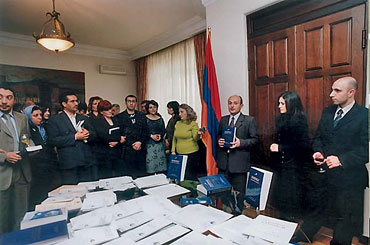
All invited guests and public participants were then offered complimentary copies of “Armenia in a Transforming World” together with a glass of Armenian sparkling wine.
Founded in 1994 by Armenia’s first Minister of Foreign Affairs Raffi K. Hovannisian and supported by a global network of contributors, ACNIS serves as a link between innovative scholarship and the public policy challenges facing Armenia and the Armenian people in the post-Soviet world. It also aspires to be a catalyst for creative, strategic thinking and a wider understanding of the new global environment. In 2006, the Center focuses primarily on civic education, conflict resolution, and applied research on critical domestic and foreign policy issues for the state and the nation.
For further information on the Center and its activities,
call (37410) 52-87-80 or 27-48-18; fax (37410)
52-48-46; e-mail root@acnis.am or info@acnis.am
|


