


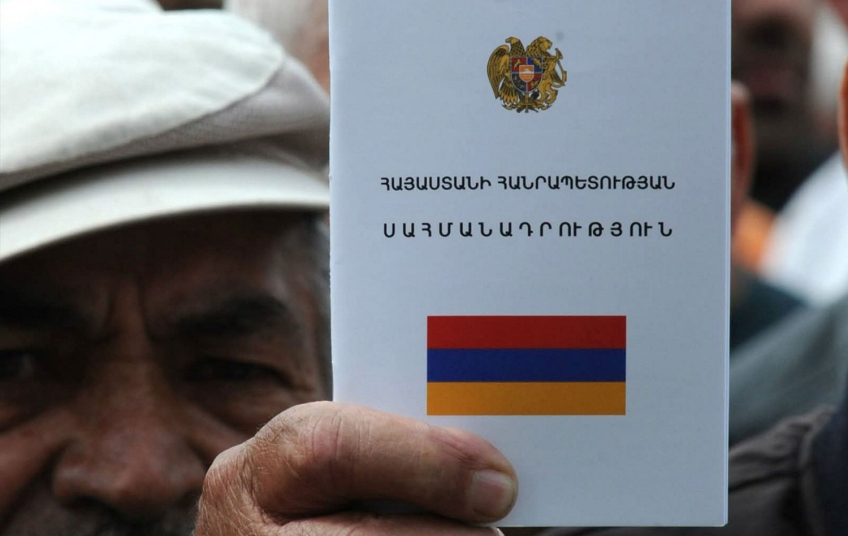

In lieu of Edito
The Constitution must protect citizens against potential government arbitrariness, not serve as a tool to suppress political dissent. The opposition represents the political will of the citizens who voted for it; therefore, suppressing the opposition is direct pressure on the free will of the voter.
I am a citizen of the Republic of Armenia and a public and principled opponent of the policies of the Armenian government, not an enemy of the Republic of Armenia. I oppose amending Armenia’s Constitution at Azerbaijan’s demand, as a precondition, or in accordance with Azerbaijan’s interpretation. I also oppose the policy of one-sided concessions in the name of peace, whereby Armenia’s sovereign decisions are made dependent on Azerbaijan’s consent. I will not accept that my position regarding the Constitution of Armenia should be determined in Baku, nor that my right to speak about it should be decided by the ruling government in Yerevan.
The latest statements made by Armenia’s head of government devalue the concept of peace; they turn it into a demand for political immunity for the government itself. Must I be prepared for government-organized repression simply for expressing my beliefs? It makes no difference whether they exert pressure on me or on a member of parliament. This is not political debate; it is political blackmail.
It is even more dangerous that such a statement comes not from a political rival, but from the head of government. The government has the right to persuade, debate, and seek support for its initiative (and I emphasize ITS initiative), but it has no right to use state resources to intimidate citizens or members of parliament, or to break their political will. The "no" of an opposition member of parliament is just as constitutional as the majority’s "yes," and the absence of a constitutional majority does not grant permission to exert pressure.
The government of Armenia is presenting its own vision of peace as the only possible option, framing those who disagree as opponents of peace, and now openly talking about pressuring them. It claims that amending the Constitution is strictly an internal matter of Armenia, yet it treats opposition to the amendment as being against peace. If this is truly a sovereign decision, why is disagreement portrayed as an act against peace, and why has Azerbaijan’s demand become Armenia’s domestic political agenda? This is an attempt to establish a political monopoly over the concept of peace and to discredit dissent.
Let us also consider this issue from the perspective of public security. Officials with administrative powers may interpret such words spoken from the parliamentary podium as a green light to target opposition-minded citizens. If doing so serves the political objectives of the authorities, the law will be subordinated to political interests, while unlawful acts will be covered up or encouraged. We have seen many such precedents. The government’s responsibility is to prevent threats of pressure and violence, not to create an environment that fosters them.
How can the government claim legitimacy for a new Constitution if it is prepared to pressure the very citizens whose rights it is obligated to protect under the current Constitution? Peace cannot serve as a justification for political blackmail, nor can the Constitution be used as a tool to carry it out.
Vladimir Martirosyan
”Hayatsk Yerevanits” Journal