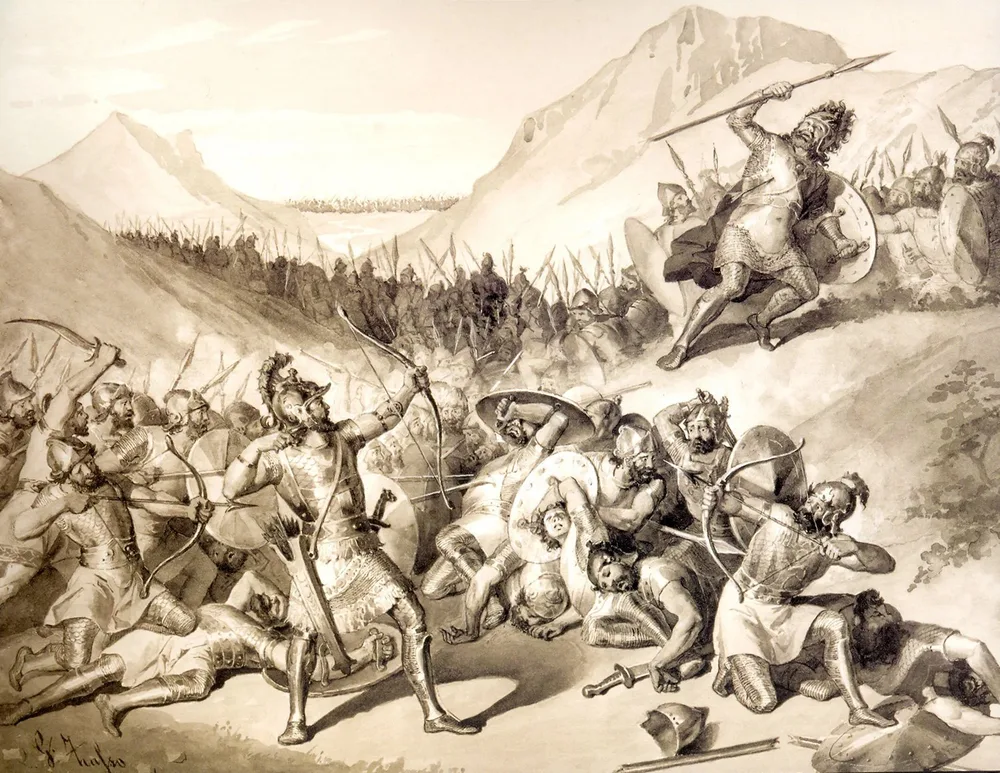
When examining the peculiarities of Armenian civilization, it is necessary to address separately its defense strategy, which was formed, refined, and ultimately reached a high degree of organization over centuries. Although from the perspective of modern theories of strategic planning its individual components might be evaluated as vulnerable or of limited effectiveness, it fully corresponded to the geographical, political, and civilizational realities of the Armenian Highlands. It was precisely this strategy that, over millennia, became one of the main pillars of the Armenian people's vital activity, the preservation of statehood, and the continuity of national identity.
The defense strategy of Greater Armenia derived from the lifestyle and peculiarities of civilizational development formed over the course of the multi-century history of the Armenian Armenian people. Dozens of state formations were shaped in the Armenian Highlands over millennia, flourishing and developing on the basis of a high level of self-organization of the settled population. Their decline was, as a rule, conditioned by external invasions, which were mainly carried out by two different types of forces: empires or communities with a nomadic lifestyle.
In the first case, well-organized, disciplined, and centralized imperial systems were able at certain periods to bring the state formations formed in the Armenian Highlands to their knees through military superiority. In the second case, nomadic tribal unions achieved success through high mobility and widespread devastation applied during conquests, which destroyed the economic and administrative infrastructures of settled communities. However, these were exceptional situations when Armenian state formations were temporarily ousted from historical processes.
In all other periods, Armenian state systems—such as the Kingdom of Van, Greater Armenia, Lesser Armenia, Sophene, and other formations—were able to maintain their place and significance in the political system of the Middle East and influence regional processes. At the core of this vitality lay the high benchmark of self-organization of Armenian society, an established system of political self-consciousness, a fully formed perception of own identity, and the continuous improvement of defense capabilities.
Precisely for this reason, over millennia, thanks to the same civilizational foundation, stable lifestyle, continuity of traditions, the dominant position of the Armenian language in the Armenian Highlands, as well as the gradual integration of tribal groups of various ethnic origins, Armenian civilization was formed. This integration also applied to those tribes (Cimmerians, Scythians, Medes, etc.) that at various times invaded the Armenian Highlands as nomads and sometimes even seized individual parts of it, but over time lost their political dominance and adapted to the natural, economic, and cultural conditions of the highlands.
As a result, Armenian civilization was perceived in the Middle East at all times as an independent and distinct civilizational entity. If we attempt to uncover the core of this civilization, it becomes clear that it is not limited to one political center or one geographical territory, although one of these centers held a predominant importance at various times. The Armenian civilizational core was formed around three main spatial units: in the Ararat plain, the Van basin, and the Mush plain.
It was the unity of these regions that ensured the formation and continuous reproduction of Armenian statehood and Armenianness over millennia. The Ararat plain, owing to its large territory and richer economic potential, in many cases became the main center of this system. At the same time, the other realms and provinces of the Armenian Highlands were constantly involved in the processes developing within this civilizational core, acting as political entities that reinforced and complemented it, making the Armenian state structure whole.
The fundamental principles of the Armenian defense strategy derived precisely from these civilizational peculiarities. At the core of the Armenian political system lay an exceptionally stable sedentarism, the natural course of which was disrupted only as a result of external imperial or nomadic invasions. The settled lifestyle, political self-consciousness, and established forms of security organization made it possible not only to withstand external threats, but even to restore independence after the temporary loss of statehood, relying on an excellent knowledge of the natural conditions of the highlands, geographical features, and the ability to gradually push out invading forces or adapt them to the local environment.
At the same time, this system was inherently devoid of expansionist logic. This was one of the most typical traits of Armenian civilization. Throughout its entire history, Armenian statehood almost never sought stable territorial expansion beyond the Armenian Highlands. This circumstance was conditioned not only by geographical factors, but also by the peculiarities of political thinking.
(To be continued)
Saro Saroyan
Machine translation · Կարդալ բնօրինակը (ՀԱՅ)