


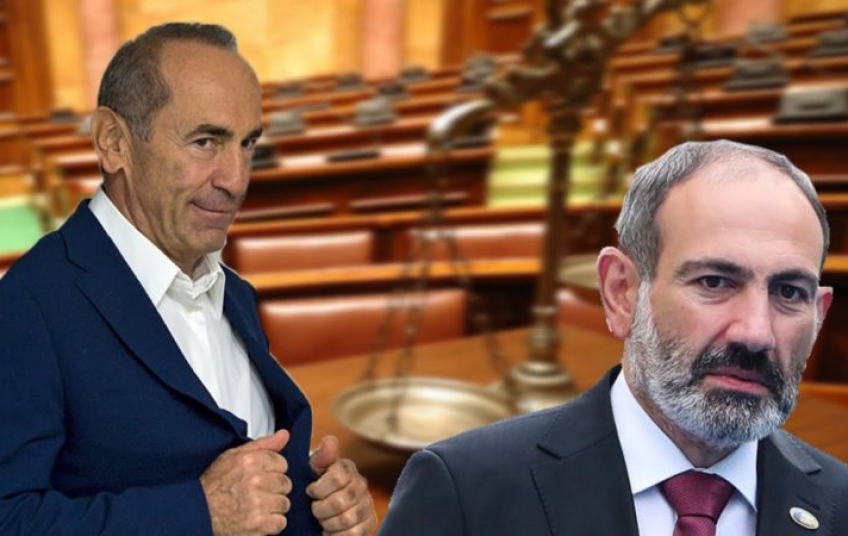

It has been for a few years that Armenia is a country with Parliamentary system of government. During those years the government failed at almost everything which was possible to fail: national security, foreign policy, economy, and culture, as well as scientific educational, healthcare and other sectors. An unhealthy moral and psychological atmosphere has been created in the country. It is difficult to unequivocally say to what extent it is conditioned by the personality of the incumbent Prime Minister and his "backpacks", and to what extent to the model of government, but it is obvious that the levers of checks and balances work poorly, enabling one person to make any decision.
It is well known that in the parliamentary model of government, it is the political parties that come to the fore, and given the super prime-ministerial system, in case of this or that result, the authority passes to that political party and that super-prime minister. And here the questions arise: what political parties do we have, are they institutionalized, do they have public trust or not? These issues are more than important because the political parties are entrusted with the system of public administration, however, the Law on Political Parties does not set strict requirements for them.
If the political parties are authoritarian structures and are dependent on one or several people, naturally, when they come to power, the state is handed over to those people and structures, without imposing control mechanisms on them. Meanwhile, the members of the political parties should be the first instance of control. The mechanisms for compiling voter lists are also important. It is no secret that we have at least one political party, whose parliamentarians submit resignations to the political party leader without mentioning a date, that is, de jure they are elected by the people, but they serve that person and are controlled by him.
In this regard, it is instructive to note the experience of democratic countries, where the political party lists are compiled during the congresses in a ranking manner, and, of course, they owe it to their constituents, not to the party leader who compiled the voter list alone.
At the same time, not only the obligatory rotation of the political party leadership should be taken into account, so that the same people are not included in the leadership positions for a long time, but also the moral qualities and educational qualifications of the parliamentary candidates, which are regulated by law in some countries. should be considered.
In short, we can talk about this for a long time. Snap parliamentary elections are expected to be held in Armenia on June 20, and we again witness almost thirty authoritarian political parties and political forces formed by incomprehensible criteria. And this is especially evident in the case of the ruling "Civil Contract" political party, which has declared itself a democratic and anti-oligarchic structure. This happened throughout the previous post-independence period and nothing has changed since then. Does everything go back to its circle?