It was September 20, 2023, in Artsakh. The car we left in was driven by my grandson. To my eyes, he grew in minutes, he aged in hours. His father was at the positions. He hastily took his father’s car steering wheel in his hands, but it didn’t cross our minds that we would leave the city. Relatives, accompanied and advised by whom he followed them by car, and soon Martakert was left behind us. But where to, we didn’t know either. We had one of the region’s villages in mind beforehand, but soon the route changed towards Stepanakert. We passed by that tank which had opened fire.
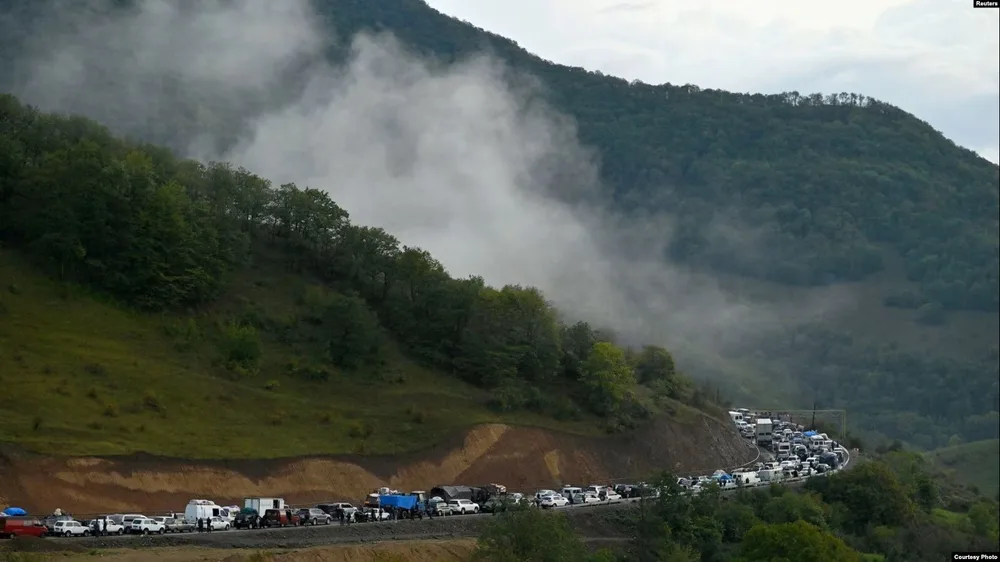
Later we learned that our tanker was firing towards the enemies who had entered the forest. Already an hour later we learned that the enemy had taken control of the inter-forest road leading to the upper villages of the region. So, we managed to get out and take the road leading to Stepanakert. Various rumors distort our minds, which were gloomy and ominous — so-and-so’s son has died, we have so many wounded, the boys are surrounded, so many villages have been emptied… And jammed roads, inhabitants of emptied villages — broken, shattered, torn apart, who, leaving their homes behind, didn’t know where to go. The road was getting longer.
Military personnel standing on the inter-forest road, whom you sometimes doubt — what if they are not ours… And, it seems, we get lucky that we pass by them "calmly" and understand that they are protecting our road. And names of victims, missing persons, wounded are being added. And villages over which the enemy’s flag is waving. With turned-off phones in our hands, cut off from means of communication. Isolated Artsakh was perishing — cut off from the world, under the gaze of the cruel world.
Ivanyan airport. Deployment point of the Russian peacekeepers. Thousands from various villages, cities. Why the forcibly displaced people concentrated right there was still unclear. It was only visible that they had accommodated several hundreds in their territory, but thousands were under the open sky — with an uncertain, hopeless fate. At least it was comforting that they wouldn’t shell there, although there was no space inside.
“The enemy is in Kashen mine,” the ill-fated news responded a day early. And the painful news following one after another continue — “We have no news from the boys at the positions entering Martakert,” “Some of the wounded have escaped, there is no information about the others,” “The boys are at the positions, they cannot come down.” Cars jammed and standing, and reaching Stepanakert becomes endless. On the right and left sides of the road, displaced people sitting in the greenery, people dragging various loads, standing in groups from old to young, small fire pits, children crying from hunger, excited, tearful adults…
The airport became a means of salvation, that at least that territory where the Russian peacekeepers were stationed wouldn’t be shelled. But are the Russians safe outside that territory, when bombs do not recognize nationality? And we hear that there are Russians who fell victim to bomb fragments. And in that turmoil, forcibly displaced Artsakh women from various villages, some with a sense of kinship that we are FB friends. And suddenly a word voiced aloud by someone, that Mrs. Natasha Poghosyan, you were writing everything right, this is what happened to our heads. We are in Stepanakert. We are broken, shattered, with swollen and tearful eyes from the sleeplessness of the previous day.
No hotel accommodated us, the evacuees — “there is no water, it doesn’t work,” “people from Hadrut live in that hotel,” “we are accommodating large displaced families,” “you can live in the basement.” Numerous reasons and the search for having a roof over our heads in powerless Stepanakert at night. And a new thought is born — we will stay in the car. This is countered by the thought “my friend’s friend is my close one.” And soon we are hosted in a genuine Artsakh family — a warm environment, soup cooking on a warm hearth, a boiling teapot, homemade coffee. And conversations through which we all pass and must pass — we must integrate or leave Artsakh.
So, we prefer the second. We are all unanimous in that matter, but our boys must come down from the positions, who are fathers of families, husbands, brothers, sons. And without electricity, cut off from the world, various means are sought: at least to have a way to know about the events happening outside by downloading cell phones in one way or another, more or less. Negotiations, 1-2 sentences about them, at least let them give a way, let us leave. And we face a severe choice — will they allow us to leave Artsakh, or are we forced to “live” with them, but as a hostage, prisoner, or deprived of liberty detainee? And among my inquiries, I see us in another situation — there was no place for evacuees in Stepanakert, reaching Armenia is impossible, and outside Artsakh we are in the status of homeless refugees with our gazes turned towards our native home.
Natasha Poghosyan
AI translation · Կարդալ բնօրինակը (ՀԱՅ)