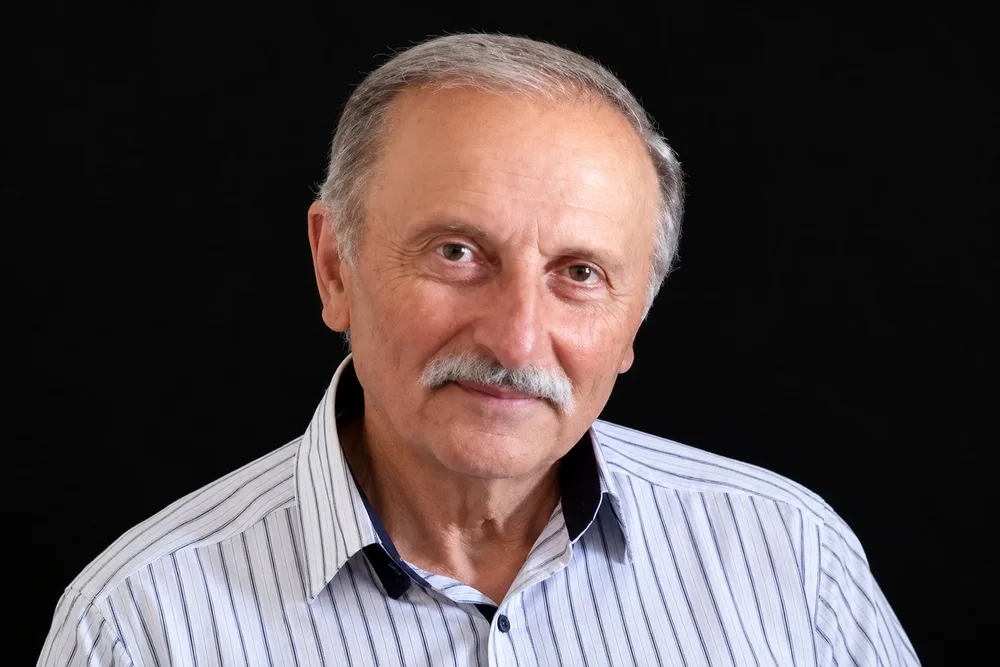
In the 1970s, a new and promising name emerged in the literary world of Azerbaijan-Armenians—Gevorg Lalayan, whose exquisite poems were published not only in the local press, but also in the “Literary Azerbaijan” magazine, the republican daily “Komunist”, as well as in Armenian newspapers and literary almanacs, and were broadcast on the republican radio. Urged by his close friends, Gevorg was preparing his debut collection of poetry for publication, which to this day remains unpublished and is now kept in his archives as a sweet memory of times past.
His literary debut was welcomed with words of praise by the renowned poets of the time Abraham Bakhshuni, Vladimir Abrahamyan, Gevorg Aghajanyan, Alek Khachunts, writer and literary critic Vazgen Mnatsakanyan, and others. Literary evenings were organized in the city libraries of Kirovabad (Gandzak) and Khanlar, and in the schools of the major Armenian villages of the region—Getashen, Azat, Aygestan, Voskanapat, Mirzik, inviting the young poet where he would read his writings and answer questions from the audience.
However, after a short period, unexpectedly for many, Gevorg Lalayan’s poetic talent, which was so brilliant and so promising, seemed to begin to fade. Months passed, a year was completed, but not a single line. As it turned out later, from his early youth, all his time was absorbed without a remainder by party and journalistic commitments. And for those close to him, who always reproached him for why he stopped writing, he had a standard “excuse”-response: “In the era of such greats as Shiraz, Sevak, Sahyan, Emin, it is difficult to be a competitive poet. Let everyone do the work for which they are called from above.”
…The adolescent had begun his first attempts in the alluring world of poetry back in his school years, when he was studying in the 9th-11th grades of the Khanlar secondary boarding school. The school was founded in the early 60s and was one of the leading educational institutions in the region. School-aged children of various ages, numbering over one and a half thousand, who came from Armenian-populated places near Gandzak (Khanlar, Shamxor, Dashkesan, Shahumyan, etc.) permanently lived, ate, and received education there.
The boarding school was a large and harmonious family, where a 14-year-old boy, having not finished the last grade of the eight-year school in the village of Kushchi-Armavir in the Khanlar region, also came to continue his studies, since after finishing the eight-year school of his native village, he would have had to attend school in one of the neighboring villages of Martunashen or Getashen to make up for the lack of secondary school, which would cause many inconveniences. Therefore, the best option was the boarding school. From those years, following the advice of his literature teacher, he began to enclose his first literary rumblings in envelopes and send them to the editorial office of the Khanlar regional newspaper “Leninyan uxiov”, in whose “Literary Page” supplement he began to be published regularly.
Immediately after graduating from secondary school, the 17-year-old teenager was offered a correspondent job at the regional newspaper, where he was already known as a beginning author. In the editorial office, there were experienced people who had traveled a long creative path, from whom much could be learned. Prose writer Saiam Baghdasaryan, poet and satirist Hovhannes Balchunas were already authors of several books, Sergey Yepisents was the author of the text of the famous song “Like a deer of the mountains…” and a wonderful feature writer. Gevorg very quickly blended into the editorial staff, loved by everyone thanks to his modesty and organization, and the high responsibility shown in his work.
He worked in that editorial office for eight years, “rising” from a correspondent to the position of deputy editor, and in the last year he was already replacing the retired editor. During this time, he also managed to receive higher education in absentia. In 1973, after graduating from the Philological Faculty of the Azerbaijan State Pedagogical Institute, he was drafted into a one-year military service, and in 1974, returning from the army, he continued his work at the newspaper.
Not long after, the journalistic talent of the republic's youngest editor, his other data and, in particular, his rapid official promotion attracted the attention of the leadership of the “Komunist” (in Armenian) newspaper published in Baku; on the pages of that newspaper, before leaving for the army, he occasionally spoke out with pressing publications. And so Gevorg, who had newly formed a family (at that time he was 25 years old), was promoted to a more responsible job: first as a special correspondent of “Komunist” in the Kirovabad-Gandzak zone, and then, two years later, to the position of head of the letters department of the same newspaper. And he was forced to move to Baku with his newly formed family, although the young family was not destined to stay there for long. But about everything—in order.
The editor of the daily “Komunist”, Hrant Babayan, was a quite hardened, tempered party-political figure, a great devotee of the press, a far-sighted, purposeful and, at the same time, very witty person, with whom simply communicating was the highest pleasure. In connection with Lalayan's official promotion in the editorial office, he had more serious intentions, but, as they say, “Friday came before Saturday.” Due to circumstances, the position of editor of the Armenian-language newspaper “Banvorakan Kirovabad” published in Gandzak was vacant in those days, and the Kirovabad City Committee of the party was preparing to nominate Gevorg Lalayan's candidacy for this position.
The redistribution of cadres had already been agreed upon with Hrant Margarich; naturally, there was also the candidate's consent. It remained for the latter to pass the interview with the secretary of the Central Committee of the Communist Party of Azerbaijan in charge of ideological work, and the proposal of the Kirovabad City Committee would then be submitted for approval to the Bureau of the Central Committee. To make a long story short. Having successfully passed the entire subsequent procedure, after working as the head of the letters department in “Komunist” for only 8 months, Lalayan, “at the call of the party,” went back to Gandzak to assume the new position of editor of the city newspaper. That was August 1977.
The editors of city (regional) newspapers of those years cannot be equated with today's home-grown editors. In the conditions of the single-party system, the editor was a nomenklatura position, the editorial office was part of the committee of the party of the given city (region)—its ideological pillar. The editor was ex officio elected a member of the party city committee (party regional committee) and a deputy of the city council (regional council) with additional public commitments arising from them. Not to mention that the editor's work in itself was a daily, highly tense, responsible obligation.
It is not for nothing that he is approved by the Bureau of the Central Committee—the highest instance of the republic's de facto power. This means that the editor becomes accountable to this high instance, and control over his activities is entrusted to the Bureau of the Party City Committee. And what it means to publish an Armenian-language newspaper in Azerbaijan, and even more so as an official organ of the party, the nuances of this peculiarity must be known to many. In short, Lalayan, who had just turned 28, takes on a burden where a slightly weak-willed person would not only forget to write poetry, but also his address and origin.
From that day until the cessation of its publication in 1988 due to the well-known interethnic clashes—for about 12 years, “Banvorakan Kirovabad” was able not only to preserve the golden Armenian language intact in the Azerbaijani environment, but also to instill drop by drop in the 45-50 thousand Armenians feelings of pride in national dignity, native language, history, religion, culture, and art. This was done mainly through the extensive coverage of events held in Armenian educational centers, anniversary dates of Armenian writers, representatives of culture, and military figures.
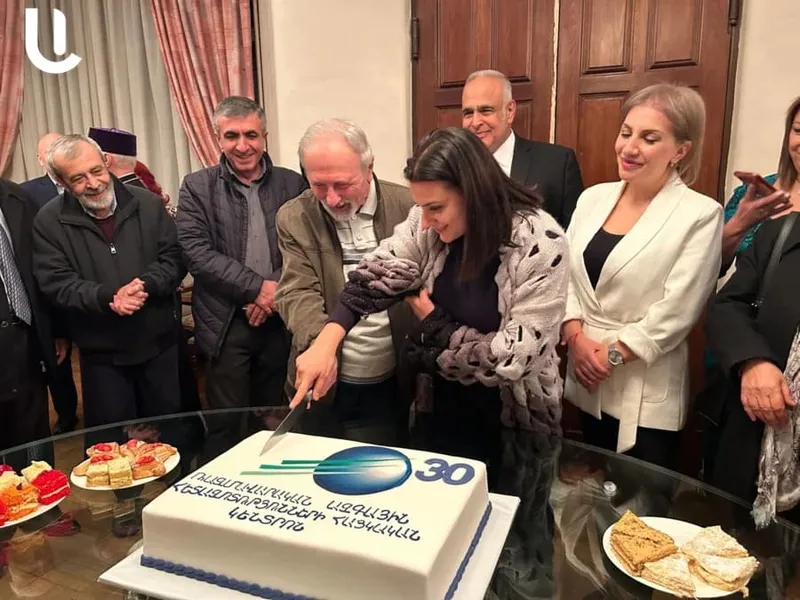
In October 1988, moving with his family (his wife, Ramela Balasyan, who was his fellow student, 14-year-old son Edgar, and 12-year-old daughter Shahane) to the city of Abovyan, RA, Gevorg Lalayan worked for some time in the editorial office of the Armenian Radio, and then was hired at the Council of Trade Unions of Armenia (CTUA) as the editor-in-chief of the magazine “CTUA Bulletins”. From 1998 to the present day, Gevorg Lalayan worked at the Armenian Center for Strategic and National Research (ACSNR) in the position of editor-in-chief of the center's analytical weekly “ACNIS reView from Yerevan”. He was 77 years old, and at that age he continued to work with relentless youthful energy and a high sense of responsibility.
Below we present a modest bunch of lyrical poems written by him in the 70s of the last century.
POEMS
Gevorg Lalayan
VIBRATIONS
There are vibrations full of life,
eternal, unquenchable.
Both in the waves of the ocean,
and in the grain of wheat sprout,
There are vibrations in the air, in the soil,
in the reflections of the sun,
In the colors of the rainbow—
refracted on the pillow of my baby.
There are vibrations, there are vibrations
in the veins of my longings,
In the eyes of girls,
in the fires of smiles,
There are vibrations that are scorching
and unquenched like the sun—
In the sway and bosom
of the young bride kneading dough.
In the soaring of swallows,
in the call-cry of cranes,
In the breath of a star, in the universe,
everywhere, in everything!
I am charmed by the vibration
of the undefiled rays of the morning,
Only the dry tree has no vibration
and the dried bed of the river.
Vibrations are the breath of the song,
they are its unbroken heartbeat…
O my song, if you have no vibration,
better never come into the world:
WHEAT SPROUT
I saw a wheat sprout on a stone,
My heart turned to soil on the stone.
Drought knelt on the soil, the tree,
My heart turned drop by drop to dew.
Lightning struck from amidst the cloud,
My heart turned to a handful of trembling.
But… the sprout grew and became an ear,
My heart turned to a joyful ray.
Wheat is fair, flour is good,
My heart turned to steel in the tonir.
The aroma of tonir bread came out,
My heart turned to a line of song.
THE CHILDREN
Careful, driver, along the road
Children are passing quietly,
Holding each other's little hand tightly,
Holding each other's hem tightly.
They are suns, each one,
A bunch of violets each,
Holding each other's little hand tightly,
Holding small flags.
From his cabin, tilting his head,
A driver grandpa is smiling:
- Have a good journey, pretty kids,-
He says and salutes.
And, although the traffic is closed,
So there is no reason for fear,
The educator is anxious—
Lest an accident happen suddenly.
Passing people smiling kindly
Experience joy at the sight of them…
And the group passes with a song,
Lining up on the sidewalk with chirping.
Countless children are passing
Along your paths at every moment,
Careful, world, on their path
Lest an accident happen suddenly.
BUTTERFLY
It was summer and Sunday,
Dust, noise and sidewalks,
In the hubbub of the city
Oh what a miracle… a butterfly.
I look at it in amazement—
This contrasting creature,
Which, leaving the charming blossoms,
Has come to the city.
Who is it looking for here,
Has it lost its way,
Or together with the flowers
Has it been plucked and brought to the market?
It was summer and Sunday,
My heart had gathered griefs,
In the hubbub of the city
A butterfly had lost its way.
GRANDPA
Grandpa was coming from the mountain,
In his hand a bunch of susambar,
The patterns of the mountain taken
Inside the embroidered saddlebag.
It was as if light was radiating
From the sway of grandpa's horse,
We were running, making noise,
Hanging from grandpa's clothes.
He was bringing mountain raspberries,
No, what raspberries, red flames…
We could hardly wait
Until he opened the saddlebag.
He distributed to all of us
What he brought equally,
Grandpa was coming from the mountain,
Inside the saddlebag—a handful of mountain.
Kajaran Images
1. THE BEZOAR GOAT
It was like a stone-built monument
A pretty bezoar goat on a rock,
A spiritual creation, a spiritual body,
We came face to face and… it remained frozen.
We came face to face and it remained frozen,
In its amorous eyes a frozen sadness,
It seemed to me that if it suddenly startled—
A thousand sparks would rise from under its hoof.
A thousand sparks would rise from under its hoof,
Stones and bushes will catch fire,
But it was standing still, watching me,
Who it was looking for in me—I did not know.
Who it was looking for in me—I did not know,
Or did it consider me an ambusher?
Inside my heart a pain of the untrusted—
I tried to take a step closer to it.
I tried to take a step closer to it,
To get closer, to hug its golden back,
But… it leapt so, flew from rock to rock,
As if thunder struck in the sky.
As if thunder struck in my heart,
A thousand flames and sparks went out in my soul,
Where are you now, on which ledge,
Oh, my proud Kajaran bezoar goat…
2. INADVERTENT ALPINISTS
The road is climbing
Up the stone gorges.
We are also climbing,
Like alpinists.
The cliff has grown a wing,
Awe is dripping from the cliff,
- Are there no alpinists?—
My question rang in the gorge.
My companion stopped,
Smiled in passing:
- Every Kajaran resident
Is an alpinist…— he said.
3. TENDER HEARTS AMONG STONES
I wandered much these bare cliffs,
I saw a thousand and one miracles—
Cliffs, gorges everywhere
Bearded and shaven.
The girls are like fire here,
Tender, like morning frost,
Every person is a bright star,
Every house is an open table.
And everywhere cliffs, gorges—
Reaching up to the throne of the sun,
There are many stones in Kajaran,
But stony hearts—not at all.
Hamo Sahyan
Advice to you from me✨
With sadness, with love,
Be intoxicated with fate,
Remain a bit defeated,
Be a bit of a god.
Bestow whatever you have,
Regret nothing,
Do what your heart desires
And be open-hearted.
Call every dawning day
A gift from God,
Call a good word you've heard
Wings to fly,
Always call white white
And black black,
At the one who looks sideways at you
You should be laughing.
And when the day passes,
Dark night falls,
When they no longer find
Me—your azure eyes
And you remain alone,
Advice to you from me:
Say Hamo Sahyan,
Sit down and cry.
AI translation · Կարդալ բնօրինակը (ՀԱՅ)