


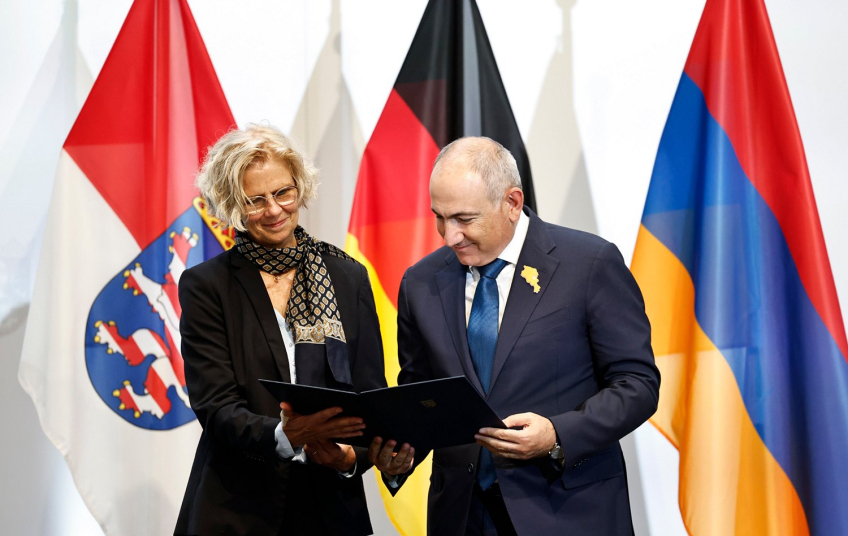

As it turns out, the process of handing the Hesse Peace Prize to Armenia’s prime minister Nikol Pashinyan on September 18, 2026, in Wiesbaden, Germany, was far from peaceful. But first, let us recall that, according to the German periodical “Hessenschau,” Nikol Pashinyan was awarded for the democratic reforms undertaken since 2018, for his policies aimed at closer ties with the European Union and the resolution of the Nagorno-Karabakh conflict. In addition to all of these merits, the prime minister’s spokesperson added another one in turn (or perhaps on her own accord), his ongoing efforts to establish peace in the South Caucasus.
Leading up to the event, a number of German human rights organizations addressed a letter to the Hessian Landtag, state parliament, its spokesperson and to the Hessian Peace Prize committee, proposing that the awarding of the prize to Pashinyan be viewed as an opportunity to advocate for the return of forcibly displaced Armenians to Artsakh, the release of 19 hostages held in Baku, and for preserving Armenian historic, cultural, and spiritual values in Nagorno- Karabakh. According to the applicants’ demand, when awarding the prize, Landtag should not ignore the most heinous crimes committed against the affected population, as well as the ongoing destruction of the Armenian cultural heritage in Artsakh having a history spanning millennia.
The signatory organizations, while supporting the peace process established between Armenia and Azerbaijan, find that peace can be just and stable only on the condition that the rights of the Armenian population forcibly displaced from Nagorno-Karabakh are respected according to the internationally established human rights norms, in the spirit of the commitments arising from the UN Genocide Convention: “There cannot be lasting peace while the consequences of the displacement, the rights of those affected and the fate of Armenians held in captivity remain neglected,” - a local group of human rights defenders warned.
Moreover, they justify their statements with noteworthy precedents from international practice. Accordingly, the former International Criminal Court Chief Prosecutor Luis Moreno Ocampo had already warned of the Armenian genocide in Nagorno-Karabakh in August of 2023, and reaffirmed what he had said in his memorial speech delivered in St. Paul’s Church of Frankfurt am Main, on April 24, 2024, underlining that mass killings are not the only form of genocide. Subjecting people to a severe psychological distress and starvation are also considered genocidal actions, both of which were employed against the Armenians of Nagorno-Karabakh. The International Association of Genocide Scholars (IAGS) agreed with this characterization, and in its September 2024 resolution regarding Nagorno-Karabakh, described the living conditions resulting from the blockade of the Berdzor Corridor as a genocidal act, and the 2023 forced displacement as ethnic cleansing.
The authors of the letter did not spare even the prize recipient, probably making it clear that “he’s not a saint himself.” This time they address the issue from a domestic Armenian perspective, focusing on the awarding Nikol Pashinyan, a political figure, during whose governance the Armenian Apostolic Church faces persecution from the state, and the high-ranking clergy, including the archbishops, who are subjected to fabricated criminal prosecutions and whose visits abroad are restricted. According to the German human rights defenders, the government is interfering with the internal affairs of the church, over which it has no jurisdiction, and denigrates the Catholicos of All Armenians, demanding his resignation, a right it has even less authority to exercise.
According to the representatives of nearly a dozen human rights organizations that signed the written appeal, the current government, and particularly Pashinyan, are also targeting the opposition figures, with whom he has filled the prisons, as well as even the affected people of Artsakh, whom he is rude to whenever an opportunity arises, blaming them and asking: “Why did you leave your homes and ran away?” or “Why didn’t you die?” and so on and so forth. “Such treatment of the victims creates a troubling contrast with democratic values and a peace prize awarded for the peaceful resolution of conflicts,” the signatories concluded.
In the end, they summarized their concerns as follows: “If the Hessian Peace Prize values the current peace process without addressing the incidents that occurred in Nagorno-Karabakh, the gravest violations of human rights and their international consequences, without taking into account the victims’ rights, then there is a danger that instead of contributing to the resolution and overcoming of the conflict, the prize will be perceived as whitewashing the crime committed.”
“Hayatsk Yerevanits” Journal