


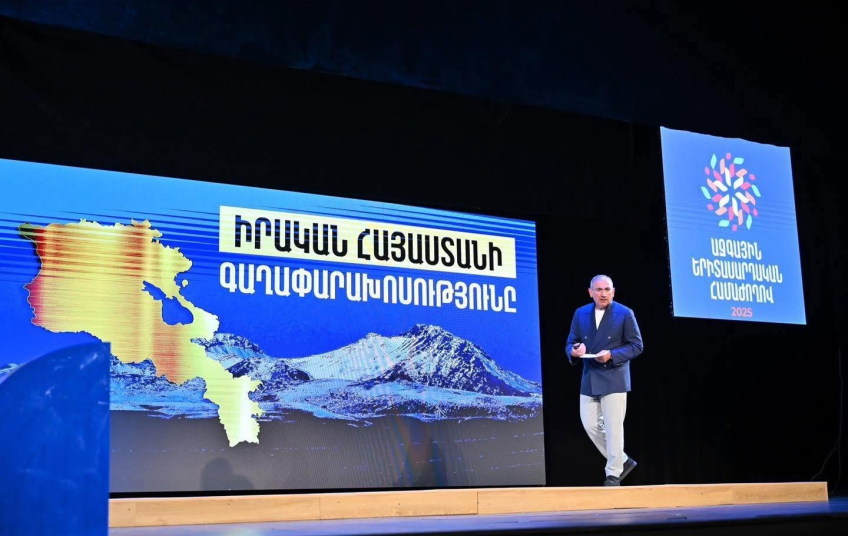

The “Real Armenia” doctrine, preached by Nikolism, is an apolitical ideology, a fact that must remain at the forefront of the Armenian consciousness. The fundamental issue is that at its core, this ideology is simple hedonism. More specifically, we term it “Armenian hedonism,” reflecting the public behavior observed during both periods of victory and defeat.
It is hedonism, because in its concept, peace is considered a means to secure a good life, which, in turn, means good-neighborly relations and trade, as well as not responding to the neighbors’ aggression with aggression. Consequently, this ideology reduces an Armenian’s political behavior to one main motive: ensuring personal comfort and the pursuit of pleasure. You can try posing this question to the Nikolists, and you will see that, from their point of view, the purpose of a human life, ultimately, is a carefree and enjoyable life. The whole ideology boils down to the following: for an untroubled life, there must be peace. And the highest indicator of a worry-free life is a feast. The phrase “He Who Rejoices Always Rejoices” (Kef Anoghin Kef Chi Paksil) is, in our perception, some sort of an expression of that apolitical ideology that Tumanyan attempted to pass on to us through his genius.
Why is this apolitical? Firstly, within that mindset, it is difficult to consistently explain why the existence of the state, national identity, historical memory, security and factor of power are independent political values. In that understanding of human relations, peace is not a result of the regulation of conflicts, interests and the balancing of power, but a state that is an end in itself, which should simply give the people the opportunity to live a pleasant life. Thus, rather than being one of the conditions for achieving political goals, peace becomes a means that replaces all other objectives.
Its extreme manifestations can be seen in cases where people are willing to set off fireworks and feast even while the bodies of their compatriots are still in the mortuary, provided only that the enemy allows them, the few survivors, the opportunity to live in peace so they can feast. An example such as this shows how personal tranquility and pleasure can become substitutes for political objectives.
This is an apolitical ideology as it rejects the role of political interests, the use of force, coercion, and competition between states, leaving these out of the political calculus. Within such a mindset, the state is gradually deprived of the internal justification for self-defense, sovereignty, and the pursuit of its own interests. The state cannot survive under such an ideology, in which the questions of its existence and security are subordinated to personal comfort and pleasure.
“Hayatsk Yerevanits” Journal