


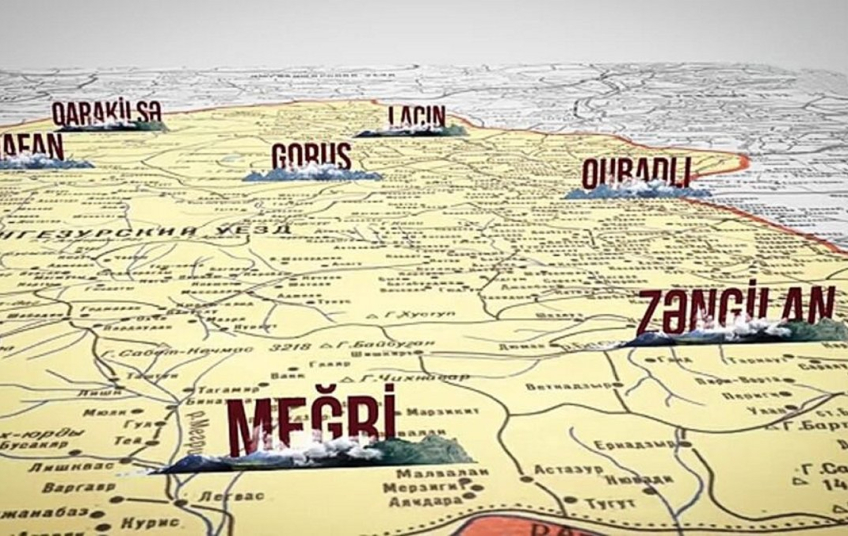

The demands that the Azerbaijani government and society have regarding the territories of Armenia no longer astonish anyone. Azerbaijan is not concealing the fact that it denies the Armenian people’s right to independent statehood. Even those Armenian experts who sought some roots of peaceful coexistence within the framework of the Nagorno-Karabakh settlement, after a short-term “peaceful” pause, understood that the situation in Armenian-Azerbaijani relations is much more complex. Ongoing debates with the Azerbaijani government and public quickly revealed other motives. More precisely, they became clearer to many. It is evident that the Azerbaijanis have a claim not only to the lands but also to everything connected to Armenia and Armenians through space and time. Many people still refuse to believe this is possible. After all, we are living in the 21st century, the age of artificial intelligence and cutting-edge technology.
This is nothing new to those familiar with the socio-political life of Soviet Azerbaijan. Since the late 1960s, Armenian history and culture have been prohibited outside everyday life. Everyone was expected to live by the following principle: in Azerbaijan, everything was Azerbaijani. Anyone who attempted to challenge this situation was immediately expelled from this Soviet republic. The conditions created within the country made it increasingly difficult to implement stable and effective state policies. In a country where Armenian stone inscriptions, spanning from the 9th to the 21st century, outnumber the present-day population of Azerbaijan, this principle imposed on public life could never truly take root. First and foremost, it poisoned the consciousness of the Azerbaijanis themselves, many of whom grew up walking past countless Armenian tombstones.
The President of Azerbaijan openly states in front of a camera that all these Armenian inscriptions were made later and must be erased. However, these intentions are causing greater harm to the consciousness of the Azerbaijani people themselves, who are confronted with the blatant lies of their own government. Every local knows when the Armenians began living in the territories of present-day Azerbaijan and how long they have lived there. And only the completely uninformed could believe that “the Armenians who were resettled here only two hundred years ago” could fill this country with their dated medieval inscriptions, from Ghazakh to Baku and from Zangelan to the outskirts of Derbent. Therefore, such an evident public lie by the head of state can only deepen one feeling in the human soul: an inevitable reckoning for this kind of treatment of the Armenian people. They saw this once, during the collapse of the Soviet Union. The feeling continues to haunt the Azerbaijani president to this day, as he endlessly repeats the word “revanchists.”
Evidently, Azerbaijani political conduct is not an isolated case. Examining the political behavior of states that gained independence surrounding the formation and dissolution of the Soviet Union reveals numerous parallels. Historical and cultural disputes are growing increasingly sharp across post-Soviet Central Asia, with a similar dynamic unfolding among Slavic nations. The detrimental impact of such discourse on geopolitical relations requires no explanation. Many nations remain unaware of the root causes behind their turn toward aggression and their refusal to grant other peoples equal rights. Unconsciously, they grapple with a profound spiritual vacuum, which ultimately strips national existence of its intrinsic meaning and projects hostility outward. As a classic author once remarked, one retains the impression that their entire existence is spent exacting vengeance upon the world for their own insignificance.
This feeling is false, of course. Everyone can express their creativity and find meaning in their existence as part of a distinct, young people. This applies to many peoples, not just newly formed ones. History and culture must be created now, setting aside the stupid notion that ethnic groups are atavism of the past. Refusing to take this path threatens to bring unprecedented devastation upon the peoples of the world, compared with which the horrors of 20th century international relations may seem merely a prelude.
Armenians must clearly understand the trend described in this text. Nowadays, when Azerbaijani territory has expanded to include “Western Azerbaijan,” extending as far as the Armenian capital, Yerevan, it is clear that “the fundamental principle of identifying everything as Azerbaijani” will quickly spread to the entire territory of the Republic of Armenia. Peaceful relations must be built with an understanding of the collapse of humanistic values in the souls of such peoples.
“Hayatsk Yerevanits” Journal