


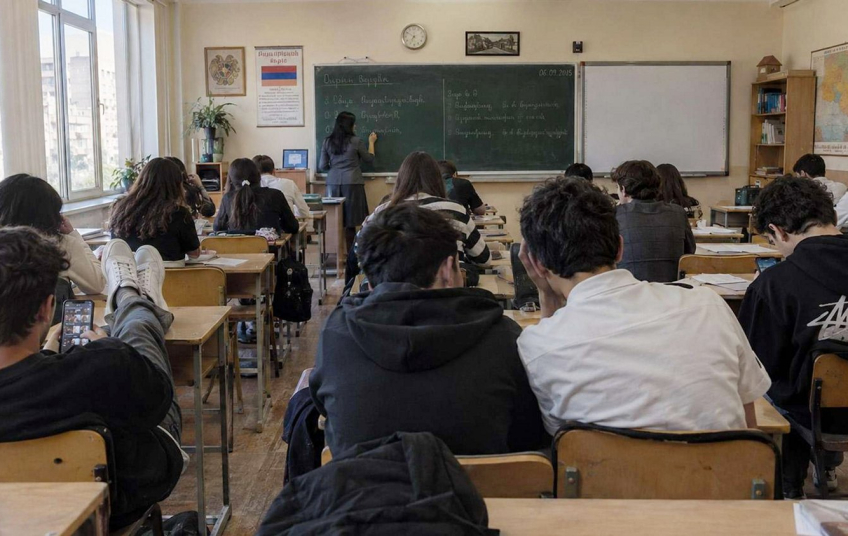

Armenia's educational system has encountered an unprecedented intellectual setback in the entire post-independence era. Armenian 15-year-olds scored below the international average in mathematics, science, and reading, ranking behind regional peers in the latest global assessment conducted by the Organisation for Economic Co-operation and Development (OECD). The findings published in the OECD’s latest Programme for International Student Assessment (PISA) survey highlight deep concerns about functional literacy, issues that have been voiced at the highest levels in this South Caucasus country. According to the results, only about 1 percent of Armenian students achieved top performance levels in mathematics, while almost none reached the highest levels in science and reading.
The proportion of Armenian students performing below Level 2, the baseline level of proficiency in tests across these three core subjects, is more than twice as bad as the participating countries' average. Only 28% of students in Armenia attained Level 2 or higher in science, compared to the OECD average of 74%. Similarly, in mathematics, just 28% reached Level 2 proficiency, against the OECD average of 65%. The lowest figures were recorded in reading test, where a mere 19% of students in Armenia attained Level 2 or higher, compared to the OECD average of 69%. In computational problem-solving, Armenia scored 354 points, placing it near the absolute bottom alongside countries like Paraguay (352) and Kenya (278).
Armenian students who scored above the baseline level of proficiency in tests across these three core subjects performed below Level 2, which is more than twice as poorly as the participating countries' average. Some 28% of students in Armenia attained Level 2 or higher in science, compared to the OECD average of 74%. In mathematics, as well, 28% of students attained at least Level 2 proficiency against OECD average of 65%. The lowest figures were recorded in the reading test: some 19% of students in Armenia attained Level 2 or higher in reading, whereas the OECD average stands at 69%. In short, Armenia ranks third from the bottom of the list with 354 points, with only Paraguay (352) and Kenya (278 points) scoring lower.
This is a profound disaster for literacy standards in Armenia, a country that was consistently top-ranked during the Soviet era. Now, it sits near the bottom out of 91 participating nations in the OECD assessment. In any normal democracy, it would take mere hours to fire the official responsible for steering the education sector into such a catastrophic state. But in Nikol's Armenia, different standards apply, the most important of which is absolute loyalty to Pashinyan. Beyond maintaining a tight grip on law enforcement, through lavish bonuses and lucrative positions he wins over compliant, uncritical, zombified allies, one of whom is the Minister of Education, Science, Culture, and Sport (ESCS).
The OECD is indeed a global benchmark in education, primarily through PISA. Every few years, PISA measures the ability of 15-year-olds to apply their reading, mathematics, and science knowledge to real-world challenges, with results closely scrutinized by governments and education specialists worldwide. Armenia participated in the PISA 2025 cycle, whose results were published on September 8 and caused immense disappointment among the clear-eyed segment of the Armenian public. Naturally, we do not expect to compete with top performers like China (where lead regions reached 93–97%), but we expected not to fall behind neighboring Georgia, Azerbaijan, and Turkey. Yet what happened, happened.
Since 2000, PISA ran every three years (except for a pandemic delay from 2021 to 2022). Following the 2025 cycle, the time between tests changes to four years, with the new four-year cycle taking full effect from 2029 onward. PISA tests demonstrate how effectively students apply knowledge in practical contexts. East Asian countries lead the world in overall performance, specifically Singapore, Japan, South Korea, Taiwan, and participating Chinese cities, while European nations like Great Britain and Estonia also rank in the top ten in reading, mathematics, and science metrics. Armenia lags behind not only its regional neighbors, but also countries like Uzbekistan, Moldova, Romania, and Kazakhstan, and others.
A few days ago, Pashinyan declared in a tone sounding almost like a threat: "We will ban teachers who have not passed certification from working in schools." In other words: "We found the culprit." Earlier, he spoke of the need for "extensive and deep reforms" in the sector. Judging by these test results, the government's strategy has yielded zero visible progress. Nor could it, you cannot manage a vital sector or craft effective policy using fake slogans, empty rhetoric, superficial ideas, and an attitude that rejects dissenting opinions. That is the real meaning behind the OECD's slap in the face to Armenia's education leadership.
“Hayatsk Yerevanits” Journal